Showing posts with label CAPS curriculum. Show all posts

Monday, February 22, 2016

Fine Motor Skills and why we should be incorporating them everyday

Our fine motor skills are the skills we use daily, but don’t think about. They are in use when we get dressed, do the dishes, tie our shoelaces, type an email, draw a picture, even eat food or a simple smile, and that conversation you had with your child? Well there are fine motor skills there as well. So, what exactly are they?

Most people know that they involve the small muscles in your hand, while few people realise it involves the small muscle movements in your face as well – your mouth, tongue and lips, as well as your feet.

Fine motor skills sometimes need a little help to develop. There are plenty of activities available on the internet for parents and teachers to have a look at, but many do not look at the implications of using fine motor skills, and why they need to be developed properly. Let’s have a look at typical development and how these skills develop naturally.

Fine Motor Development Skills by Age
0-6 Months
·      Reflexive grasp – this should be present at birth
·      Uncontrolled or Involuntary Reaching for objects
·       Voluntary grasp
·       Using 2 hands to grasp something (whole hands, also known as the 2 handed palmar grasp)
·       By 5 months, a 1 handed palmar grasp
·         Controlled reach by 5 months
6-12 Months
·         Reaches and grasps objects, puts them into their mouth
·         Able to release objects in a controlled manner
·         Development of the pincer grasp – using the forefinger and thumb to pick up small items
·         Moves items from one hand to the other hand
·         Is dropping and picking up toys
1-2 Years
·         Building a tower of 3 or more blocks
·         Can put pegs into a pegboard
·         Turning the pages in a book
·         Scribbling
·         Paints with whole arm movement
·         Beginning to feed themselves
·         Can hold and drink from cup independently
2-3 Years
·         Beginning to thread using large beads
·         Can now turn single pages in a book
·         Starting to cut with scissors
·         Can hold a crayon, not using the fist grip
·         Beginning to use dominant hand more and more
·         Uses wrist action to paint – no longer whole arm movement
·         Can roll and pull playdough
·         Can now eat without assistance
3-4 Years
·         Now able to build a tower with 9 blocks
·         Can copy a circle and a cross
·         Can make simple items with playdough – rolling into a snake
·         Uses the non-dominant hand to help
4-5 Years
·         Can cut on a line continuously
·         Copies a cross and a square
·         Can write their own name
·         Writes number 1-5
·         Able to copy letters
·         Established dominant hand
·         Can get dressed and undressed independently
5-6 Years
·         Can cut out simple shapes
·         Can copy a triangle
·         Can also colour in between the lines
·         Is able to hold a pencil with the tripod grip – thumb, forefinger and index finger
·         Can glue paper
·         Able to draw a basic picture
6-7 Years
·         Able to form most letters and numbers
·         Can write on the line
·         Has control over pencil movements
·         Able to build Lego or similar building blocks
·         Can tie own shoelaces

Not only do these motor skills help us eventually with writing and tying our own shoelaces, they also have an impact on our cognitive functioning.
Our motor movements have been found, with the use of neuroimaging techniques, to be linked to the cognition centres of the brain. Fine motor skills have been found to be a strong indicator of later cognitive ability, particularly reading and math skills.


This is why they are important skills to develop, and when we see them lacking we need to help out. To help you out, we have developed a fine motor checklist with activities to help identify if there is a gap in the development process. 

Tuesday, August 18, 2015

Using Independent Work Binders in the South African Mainstream Classroom

Independent binders are a great way of helping the learners in your class develop independent learning. This, I find particularly true in a special needs environment. Not only is it true, it is also an essential part of a special needs classroom.
But, while I realise just how important this is in my special needs classroom. I began thinking about how they can be used in a mainstream class. 

Create centers in your class
Have an area in your classroom which your learners are able to access throughout the day. In this area, place a learning activity (read:binder) which your learners need to complete at some point throughout the day. In order to do this, laminate the pages of the binder you would like to use, and supply the area with whiteboard markers for your learners to use. This activity may be math, literacy, or life skill related. It may even be an art activity. Not only, are you able to assess their level of independence, but also their level of task initiation, and task completion. 

It may also keep those fast workers occupied for a little while, and give you some time to work with your weaker learners. 

Make flashcards
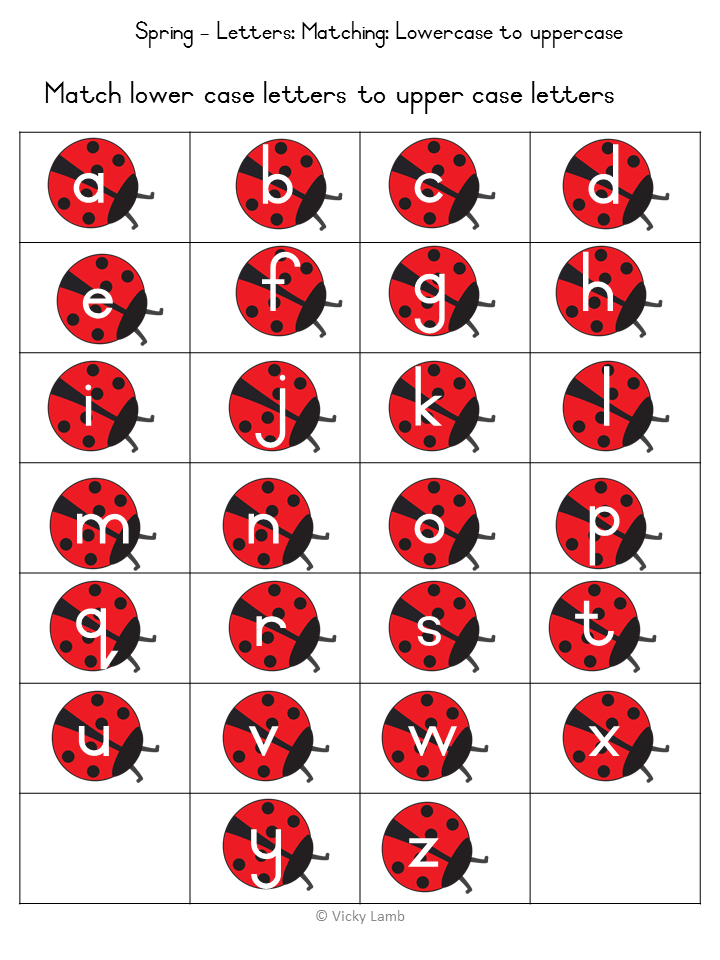
Use these to create ladybug themed
 flashcards
The binders do not have to be used strictly in the sense that you would like them to be used. You can also use them as different themed flashcards. Take the Spring themed bundle and create alphabet and number flashcards as well as colour flashcards. 

Or create snail themed flashcards.
Play games
You can play games, such as snap, or even memory with what is included in the bundle. Again, print and laminate what you need and you have an instant themed game for your class. Remember, if you have different levels of groups in your class, while you are focusing on one group, you may be able to keep the other group occupied with a game. Or, use the game as a fun reinforcement activity of a concept you have been teaching. I always find games seem to help get the concept across.

If you have any more ideas, please feel free to share them in the comments below.


Sunday, September 21, 2014

Reading Eggs

I recently stumbled onto a wonderful set of apps developed by the Reading Eggs team. Don't let the name fool you though. They have also designed apps for numeracy. 
Together with their apps, you are also able to create an account on their website, and follow each childs' progress. 
The apps are really great, and the kids in my class have thoroughly enjoyed working on them - in fact they will choose these apps instead of games!! Below is just a few of the apps that I have had the opportunity to work with:


  • Eggy Phonics 1: Short vowel words

Eggy phonics allows you to create as many users as you need, which is really fantastic if you only have one tablet in your classroom. It will also show you the progress of each child, therefore allowing you to see where a child is struggling, and also giving you the opportunity to help that child. 

Once you have selected the child's name, you are taken to a screen which will have two options - words or reward game,
The words game, is a graduated level game. You start on level 1, and with the word cat. Once you have completed all 6 activities, you are then given a short reward and are moved onto the next activity. 
Activity one, is a simple match the word spoken to the correct picture, after completing this level correctly you must then spell the word - this gives you both the letter name and the letter sound. After completing these activities twice, you move onto bubble words - you have to pop the bubbles to spell the word. Your final activity is writing the word. You then earn a badge, and depending on how well you have done, you are awarded a certain amount of game time - you may use your game time straight away, or save it until you have a certain amount,

Eggy phonics begins with the -at word family and moves through the different families.

  • Tap the Cat
Tap the Cat has various activities, ranging from Speak and Listen to Draw and Paint.

1.     Speak and Listen
The app will show you the word, and you then need to record yourself saying the word - great for those battling with a speech impediment.

2.     Smart Quiz
Here, you need to listen to the question and then select the correct question. This I find really useful when working on auditory perception skills. It begins with questions such as; “I can moo. Who am I?” It covers animal sounds and identification , initial sounds as well as associations and colour identification.

3.     Letters
The child must find the matching letters. This activity will help the child learn both the letter name and the letter sound.

4.     Writing
After writing the word, the child is then able to save their best attempt at writing the word.

5.     Sight Words
Take the bunny home to complete this very cute activity. Get the bunny to jump to the correct word until you have eaten the green carrot.

6.     Vocabulary
Matching the word to the picture – touch the word and then select the correct picture.

7.     Time to Rhyme
This activity begins with a good description of what rhyming words are. You are then given a sentence such as; On the house I see a ______ . To complete the sentence, you will need to choose the correct rhyming word.

8.     Draw and Paint
This is a fun activity, your child can paint 6 different pictures.

Eggy Words 250 HD

This is one of the favourites in my class. This is a variety of sight words, which appear on the screen on eggs. You need to touch the correct word. You can choose different speeds and levels. This is a great activity to help with visual tracking.

Eggy Add to 20


In this app there are various games to choose from; balloons, teddy, snowboard, sheepdog, memory and fishing. You are given a sum, and then need to choose the correct answer. With this app, the activities are all very different and require different skills. Some require you to find the answer, while others require you to work out what numbers will give you the answer.

 All of these apps are available in the South African App store as well, and are R24.99 each.


Wednesday, July 9, 2014

What to do for Mandela Day (18/06/2014)


So Mandela day is approaching, and we have all heard about the 67 minutes of doing something good in our communities, or for those who are less fortunate. Many of our kids are currently on holiday, but that is not a reason to let them stay at home and not get them involved. And for those teachers who are working, get your class involved. 

Lets create responsible citizens who give back to their society or community. But, what should we get them to do?

Teachers:
  • Start a blanket/food drive for those who have no blankets or food - particularly in this cold weather. When you have collected a certain amount, get the kids to hand over the items.
  • Collect food for the local animal shelter, or blankets. They are always appreciative of any donations.
  • Run a soup kitchen from your school for the day - approach a local supermarket and ask them for donations, let the kids make the soup and hand it out. Get the parents involved for this one.
  • Ask the kids to collect books, and donate them to a poorer school - you could also get the kids to read a story.
  • Go pick up litter outside of the school grounds.
  • Take the children to an old age home or an orphanage and let them read to the elderly or abandoned. 
Moms and Dads
  • Get your kids to sort through their toys and clothes and donate them.
  • Spend a day at an animal shelter and offer to take the dogs for a walk, or play with the cats. If you're feeling brave, help clean out the enclosures.
  • Go pick up litter around your neighbourhood.
  • Take some flowers, or bake something nice to take to an old age home or an orphanage. 
I'm sure there are many more things to do, these are just a few suggestions. And as long as we keep giving back and helping others, we will be living up to the expectation of Nelson Mandela, and hopefully contributing somewhat to the legacy he left behind.

For more information go have a look at, http://www.mandeladay.com/


Friday, July 4, 2014

Why I no longer use time-out in the classroom


As teachers we have all heard how important it is to establish discipline in your classroom. And it is! However, it is also just as important to know HOW to establish a culture of discipline in your classroom.

Too much, and you will crush personalities, too little and your learners will run riot in their  classroom. So, how do we establish a balance of just enough and what types of discipline should we be using.
There are various points about discipline that we are always taught use, one of these being consistency. But, does this mean consistency for the whole class? One punishment for one crime? I disagree.

Children are unique individuals, just as adults. We all have our own belief systems and our own morals, and so do children. We want to help these children develop their personalities, and develop their morals and belief systems, and in order to achieve this we need to give them the tools to help them achieve. And, so I no longer use time-out in my classroom.

Why? Well, when you think about it, what is time-out actually achieving in a work environment? Nothing. You are allowing that child to get out of the work they are supposed to be completing, you are almost rewarding them, and saying to them, don’t worry, you can come back to this later. Some children, may purposefully look for ways to get themselves into a time out. It prolongs task completion, and the child ends up resenting you, as they still have to do the work later on.

Yet, what other methods should we be using? Well, how do you get yourself to complete a task you do not want to do? We use rewards, if I finish this task, I will let myself read some more of my book, if I quit smoking, I can save up some money to buy that really expensive gadget I want.

And now, I would like to challenge you all to use this in your classroom. When you have a child who does not want to complete a task, put a positive spin on it. If you complete your maths work, you may have 5 extra minutes of playtime, if playtime is what they enjoy. If you have a child who enjoys reading, give them extra reading time. Reward them for good and stop punishing them for the bad behaviour.

I also just want to say, that time out does have its place. In the playground and at home, but let us stop using negative punishment in the classroom and start rewarding, and providing an environment in which to reward. 

Monday, May 5, 2014

Getting parents involved in their child's education Part 1 - ECD

It is important for teachers to be involved in their class' education, but more often than not our parents take a backstep. This can be immensely frustrating! We know that children benefit more from involvement from both parties, but we don't often see this. So how can we encourage this?


  • Create a question box
Create a box with very simple questions in it. Every morning parents need to look at a question in the box and discuss it with their child.


  • Stay and Play Day
Have the kids create invitations to their parents, and invite them to the school for an afternoon. Not only will this encourage positive relationships between staff and teachers, but will also encourage relationships amongst parents. This may be particularly helpful for new parents. Have some organised games prepared as well...


  • Guest Speakers
Most parents sometimes feel intimidated by their child's education and may not know how to get involved. Have an information session, be open with your parents or get in a guest speaker to specifically discuss learning opportunities for parents.

Lastly, develop a relationship with your parents. Take some time and get to know them, they may just need someone to chat to.


Saturday, May 3, 2014

How to show parents just how important reading at home is.


I can remember being read to from a very little girl, and then I started reading myself. I have always loved books, and a good book is a great form of relaxation for me. While this is true for many of us, many children grow up without books in their house and without learning to love books. So how can we change this? And, really how important is it?!

Well to start off with, tell your parents that they only need to do it for 20 minutes a day (I'll explain this just now). Make it fun though! Most of my experiences with children who do not want to read, are simply bored and uninterested in what they are reading. Take topical topics, their favourite show, favourite celebrity and let them read about that.Use the child's interests to allow them to foster a love for reading and books.
But now, back to the 20 minutes, a child who reads for 20 minutes a day, will by the end of their sixth grade have been exposed to 1 800 000 words! That is quite incredible!

Included is an infographic that details the above.


So next time you have a parent complain to you about reading homework, show them this!


Tuesday, April 29, 2014

Turn Your Class Into A Democracy


With the elections coming up we, as teachers, have a golden opportunity to turn our classrooms into a democracy and educate our learners about what is about to happen in our country.
It's real life, it's what mom and dad are talking about and it's important to learn about. So, how do we do this?
Use what you have in your classroom. And keep it simple. Maybe even decide on some new class rules. Or the themes that you want to use during the term.
Let's take the theme option for now. Give your class an option of themes, so, dinosaurs, wild animals, pirates, insects, books, pets, our country, food, shops and transport. That's 10 quite exciting themes, but you only have 4 weeks. Draw up a voting sheet with pictures and words for each theme. Download my example here.
Let your class vote on a Friday, and use the week before to explain each theme briefly (kind of like the way political parties describe themselves). Explain to you class what confidential means, and that it's their vote, and nobody else's.
On the Friday, set up your class as a voting station. Explain the procedure (maybe even include this as a schedule). Let them queue up outside, come in (they could even have ID books that you can make - see mine here). Stamp their books, take their fingerprint, and mark their thumb. Give them their sheet and let them go into a little cubicle to place their X. And then post their ballot.
Once everyone has completed this, bring them all into the class and explain that the themes with the most votes will be the theme for the term.

Take the votes out of the box, draw a tally table on the board.. And wait to see which themes will win.  

Thursday, October 24, 2013

A good letter sound app and some indoor fun

The last week has been quite a fun week in class, but today I had to deal with some behaviour issues! Having dealt with all of this we decided to have some fun in the class again. And so started the mildly chaotic game of balloon tennis!
All you need is a few balloons, some paper plates and some rulers. Get the kids to decorate their paper plates - you could even turn this into a sensory activity and get them to use finger paints (also great for fine-motor)! Grab the rulers and tape them to the back of the paper plates - and you have some racquets! Now all you need are the balloons. Try and have enough balloons for each child (if your kids are old enough, get them to do some oral motor exercises by blowing up the balloons), blow them up and now you have balls! So you're ready to start, throw the balloons around and get them to hit the balloons. This is such a great activity for eye-hand coordination, as well as building that shoulder stability and strength that is so incredibly important for handwriting and fine motor dexterity!
Needless to say, the behaviour has improved from everyone! We all had a great time, and when we sat down to do some literacy work, the focus was incredible!!
So what literacy work did we successfully cover today? Well, it includes a free app!!

Little Matchups ABC is really great! It has an option to change the settings, so you can switch off the letter names, and it will only use the letter sounds - which for us South African Teachers is really fantastic! It teaches the child to identify the capital letter and the small letter. The voice over announces each sound as you touch it, you then have to match the small letter to it's capital. It's a fun app with some interesting sounds to motivate the child, and when an incorrect answer is put in, it gives a wrong answer sound and moves the letter away from where the child has incorrectly placed it! I have given this app 3 stars, as it is free, there are no in-app purchases, however it is rather simple and will probably have a very short lifespan in your classroom! Added to this, it does not provide you with any data about how the child has done so you need to be watching to see what they get right or wrong!

Tuesday, October 22, 2013

Proudly South African Resources

The app rubric is still under construction, but coming along nicely! Remember, you can make your own one to assess apps! And, don't forget about google!! There are plenty of app rubrics out there!

In the mean time, I thought we could do with a list of resources. (To clarify, Ryan, the boyfriend, thought of this one!).
There are so many resources available to teachers as well as parents, but yet not many of them are South African! There are a few that I have come across, and which I have found quite useful.

The first one to look at is e-classroom.This site has a wealth of free worksheets, all aligned with the CAPS curriculum, not only are worksheets available but plenty of lesson plans and ideas for all grades, right from grade R to grade 12! Everything is organised in it's respective grade or theme and you can also search for specific items. Natalie Wood, the founder of e-classroom, has put together a selection of beautifully designed worksheets which are really great to reinforce concepts you are teaching. For me, as a teacher (and parents, you can also use this site to help clarify tricky concepts) this is definitely one of my "go to" sites!

Another site to look at is; sahomeschoolmum. She has some amazing items on South Africa, such as a money poster! Go have a look! These are all free and you can print them in your own time! There are also maths and literacy resources as well as activities you can do with your child.

The last one that I stumbled upon is edchatsa, while this site has less resources it has forums and regular discussion evenings. As I have only just discovered this site, I am still learning about it myself but it does look to be very promising!

Of course there are many many resources available on the internet now, and all you really need to do is be an avid pinterester! As a teacher this is by far one of my favourite resources to utilize when I am stuck, not only for worksheets, but for activities that are concrete enough for my kids to pick up!
For me, one of the most important parts of teaching, is having fun with your students. So find activities that are fun, release your inner child, and they will have fun and unknowingly learn!

Sunday, October 20, 2013

Evaluating apps for the South African CAPS curriculum

One of the hardest parts of choosing an app is deciding if it will assist you in achieving the skill you are trying to teach. There are various resources on the internet which will tell you if an app is aligned to the common core standards or CCS in America, but hardly anything for the South African CAPS curriculum.
And so we are often left downloading apps that do not target the skill we were hoping for (although we may be able to use this app either for foundation skills or for extended work).
Because of this I have started working on a rubric which will hopefully allow us to choose apps that are better suited to our learners and the curriculum we currently employ in our schools. However, in the meantime a good bench mark to use is that of Kathy Schrock.

She has designed a rubric called the evaluation rubric for iPod/iPad apps. This rubric is quite useful in determining how appropriate an app may be for the skill you are trying to teach and therefore allowing you to make a better decision about the app you are considering. Go have a look at it here - iPad rubric

In the meantime, I would like to ask all of you for your help in the development of this rubric and ask you to let me know what you believe should be in the rubric? For me the most important aspects of an app are:

  • Does it offer differentiated learning?
  • How motivating is the app?
  • What is the cost and does it include any in-app purchases?
  • How can I adapt or customize it to my learners needs? 
  • Does it provide me with a summary of my learners at the end of their session?


For me, differentiated learning and customization are incredibly important as I teach special needs students. However, due to the varying teaching methods worldwide I feel that customization is possibly one of the more important aspects anyway. So let me know what you think? I have also included a poll so please vote...